
Learn each control on a short stretch.
Use the game’s displayed control hints before taking a fast run. The reviewed motorcycle controller separates acceleration and braking from left and right body rotation. A forward input is therefore not a replacement for balancing the bike.
Begin with a short, controlled approach to the first obstacle. Notice how the bike responds when you release the throttle, brake, or make a small angle correction. A slower opening attempt gives you a clearer picture of the physics than holding several controls at once.
- Check the current course and the control hints shown by the game.
- Use a short throttle input on a safe stretch.
- Make a small balance correction and watch the bike’s angle.
- Approach the first ramp with enough speed to climb, while leaving room to adjust the landing.
Plan where both wheels will arrive.
Before a ramp, look at the landing surface and the obstacle beyond it. Too much speed can carry you past the useful landing area. Too little can leave the bike falling into the gap. Adjust the approach before the jump rather than expecting a large mid-air correction to solve everything.
In the reviewed controller, left and right inputs rotate the bike both on the ground and in the air. Short corrections give you a chance to observe the new angle. Holding one direction through the entire jump can keep rotating the bike after it has reached a useful landing position.
Aim for a landing that preserves control for the next section. A dramatic rotation is not automatically a better move. First learn a reliable crossing, then experiment with a faster or more ambitious route if the game’s current course allows it.
A checkpoint helps a run; it is not a cloud save.
The available project sets checkpoint flags and records the checkpoint’s position when the rider crosses its trigger. The fall handler uses those flags, together with a respawn-availability condition, to choose between recovery and the game-over flow. Crossing a checkpoint is therefore useful even before you have finished the course.
This does not promise that every fall produces an immediate free respawn. Follow the recovery choices the current game actually shows. A checkpoint position within an attempt also does not establish that the same position survives closing the page, switching browsers or opening the original game in another tab.
Use a retry to answer one question.
The project treats the finish trigger and collectible stars as separate events. Reaching the finish opens completion behaviour; collecting a star updates a separate counter. Seeing a collectible is not the same as completing the route, and this guide does not claim that every course requires the same collection total.
After a failed attempt, identify one likely cause: approach speed, bike angle or a late correction. Change that one part on the next run. Keeping the rest of the approach similar makes the result easier to learn from than changing every input at once.
We have not completed every course or verified optional reward and purchase flows. Use the current level’s own result panel for its completion status and available next step.
How we checked this guide.
On 25 October 2026 we reviewed the available project’s motorcycle controller, checkpoint triggers and completion handling. Those project-code findings explain the mechanics; we have not established a byte-for-byte match between the local checkout and the hosted Unity build.
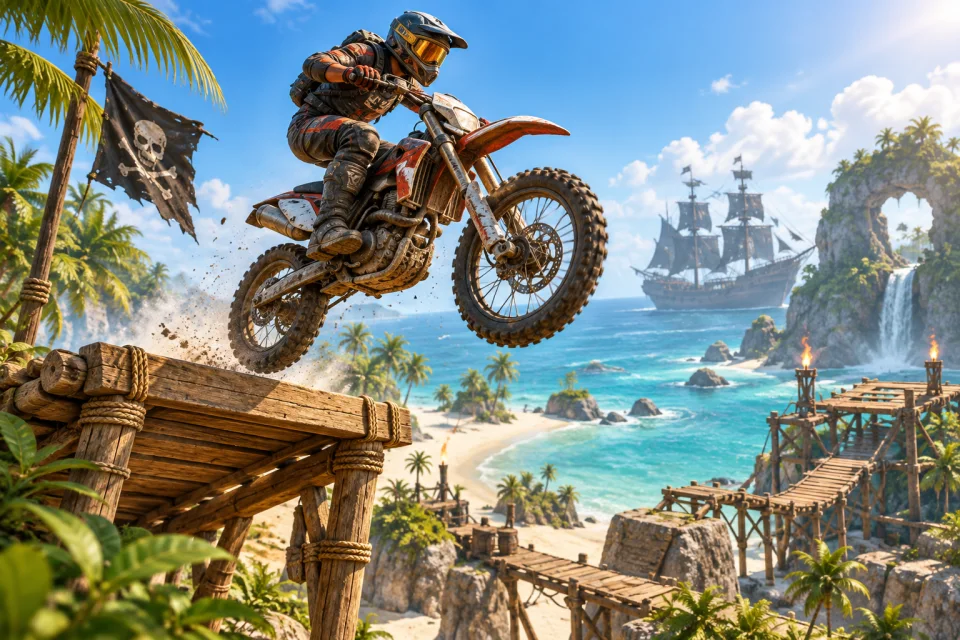
The catalog-player load timed out in this browser check, so we have not verified an active course or performed the inputs described by the project. The illustration above is the catalog cover, not a gameplay capture. We have not verified persistent checkpoint recovery, physical-phone controls, every level or optional advertising rewards.
For the scope of our guides and corrections, read our editorial approach. If your screen behaves differently, send the player link and steps in a game-specific report.